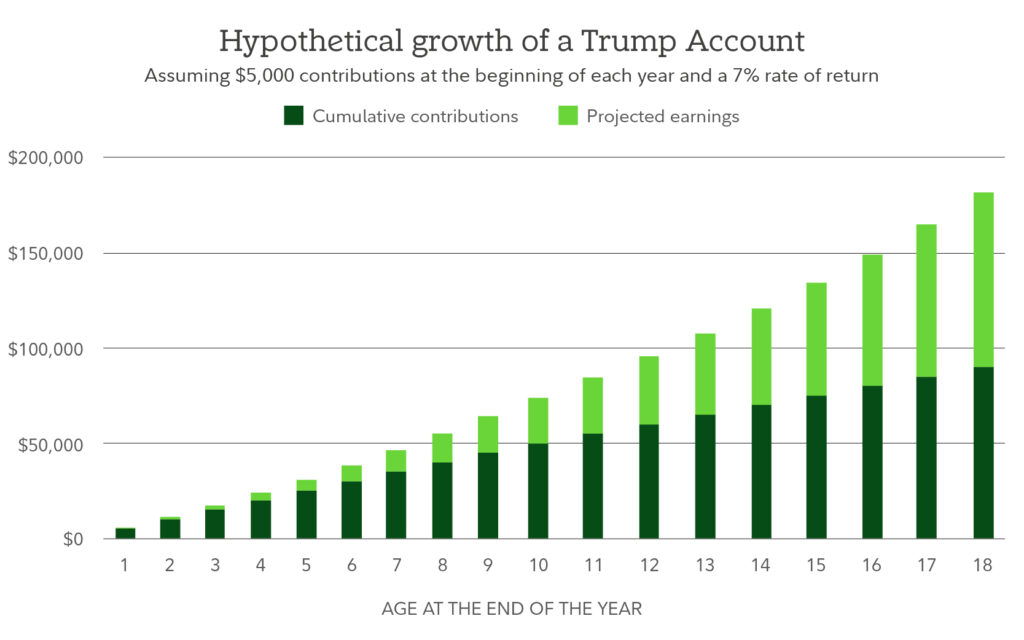
If you’ve seen headlines suggesting Trump Accounts could turn a newborn into a millionaire, it’s understandable to feel two things at once:
- intrigued (because a head start sounds amazing), and
- skeptical (because “guaranteed growth” is not how investing works).
This post is here to slow the conversation down and make the math feel understandable.
What Trump Accounts Are (In Plain Language)
Trump Accounts are a new, tax-advantaged investing account for kids under 18. The key idea is simple: give a child time in the market, with guardrails, so money has decades to grow.
A few basics to know:
- Some children qualify for a one-time $1,000 “seed” deposit from the government (a pilot program). Eligibility is tied to birth dates (2025–2028) and citizenship and Social Security number requirements.
- Families can start the setup process through their 2025 tax filing using IRS Form 4547, which is the election form tied to opening the account and requesting the pilot deposit.
- Contributions themselves do not begin immediately. IRS guidance notes that contributions generally can’t be made before July 4, 2026.
- Investments are restricted at first to low-cost, broad U.S. stock index funds (mutual funds or ETFs) with a fee cap and no leverage.
(That restriction is meant to keep the account simple and low-cost. It also means you may not get to pick from a giant menu of investments early on.)
Definition Moment
When we talk about Trump Accounts, we don’t mean a magic path to a guaranteed outcome. We mean a long-term investing account that can help a child build familiarity and assets over time, as long as the contributions and market returns cooperate.
Why The “Millionaire” Projections Get People’s Attention
Growth projections are mostly compound math. Small amounts can become meaningful amounts when you give them time.
But projections can also quietly depend on assumptions that real families don’t control:
- future stock market returns
- inflation (what money will buy in 20–30 years)
- fees and fund expenses
- taxes at withdrawal
- how consistently a family can contribute year after year
Even TrumpAccounts.gov notes that its estimates are illustrative, based on historical S&P 500 averages, and not guaranteed.
Separately, some long-range market outlooks from major firms have projected lower future return ranges than “historical average” figures, which is one reason advisors caution against reading best-case projections as expectations.
A More Realistic Way To Think About Growth
Here’s a calmer framework we like:
1) Separate “possible” from “probable”
A million-dollar balance by a child’s late 20s can be mathematically possible in a spreadsheet. But it usually requires some combination of:
- max contributions for many years
- strong returns over a long stretch
- minimal interruptions (life is rarely that tidy)
That doesn’t make the account “bad.” It just means the headline is not a promise.
2) Remember inflation
Even if an account grows dramatically, future dollars typically buy less than today’s dollars. For example, $1,000,000 about 28 years from now could have the purchasing power of roughly $440,000 to $500,000 today (depending on inflation). This is why “real” outcomes can feel smaller than “nominal” numbers.
3) Fees and taxes still matter
One positive feature here is the fee cap on eligible investments (0.1% in the guidance).
Taxes are more nuanced. Contribution sources can be treated differently, and earnings are generally taxable when withdrawn. A plain-language explainer from Fidelity Investments walks through how individual contributions and employer contributions can affect taxation later.
If your eyes glaze over at that last sentence, you’re normal. The takeaway is: this is not “tax-free forever,” and it’s worth understanding how withdrawals are treated.
Questions To Ask Before You Open One
If you’re considering Trump Accounts, here are practical questions that keep the decision grounded:
- Are we eligible for the $1,000 seed deposit? (Birth year, citizenship, SSN.)
- How do we open it in our situation? Many families will use Form 4547 with their 2025 return, and the IRS has detailed instructions on how that election works.
- When can we actually contribute? Contributions generally start later (not before July 4, 2026, per IRS bulletin guidance).
- Will an employer match or contribute? Some employers may choose to contribute, and there are rules around how that interacts with annual limits.
- What are our “why” and our “timeline”? Education? First apartment? Long-term foundation? (This is also where comparing a 529 plan vs custodial investing vs other options becomes useful, and we’ll be writing more about those comparisons.)
How Trump Accounts Compare To Other Ways Families Save
This is where we recommend stepping back and thinking in “buckets,” not “one perfect account.”
- If your main goal is education, you’ll likely want to compare this with a 529 plan.
- If your main goal is flexibility, you’ll likely want to compare it with a custodial account (UTMA/UGMA style structures).
- If your main goal is building a child’s investing confidence, the simplest win is often: open the account you’ll actually use consistently, even with small contributions.
Trump Accounts may end up being a strong addition for some families, especially if the seed deposit and any employer support are available. But they don’t replace the basics: steady saving, clear goals, and a plan you can repeat.
What We’d Do Next (If This Were Our Family)
A simple, low-pressure next step could look like this:
- Confirm eligibility and understand the setup process through the IRS.
- Decide on a realistic monthly contribution that won’t create stress.
- Keep expectations calm. Use projections as “what might happen,” not “what will happen.”
- Revisit annually alongside other goals (education, emergency fund, retirement).
Every family’s situation is different. Before taking action, make sure you understand how the rules and tax treatment apply to your household.
Save this and share with a parent or caregiver who’s seeing the same headlines.
Comment with your questions and we’ll translate the fine print into plain language.
Disclaimer: This is general education, not personalized financial advice.